
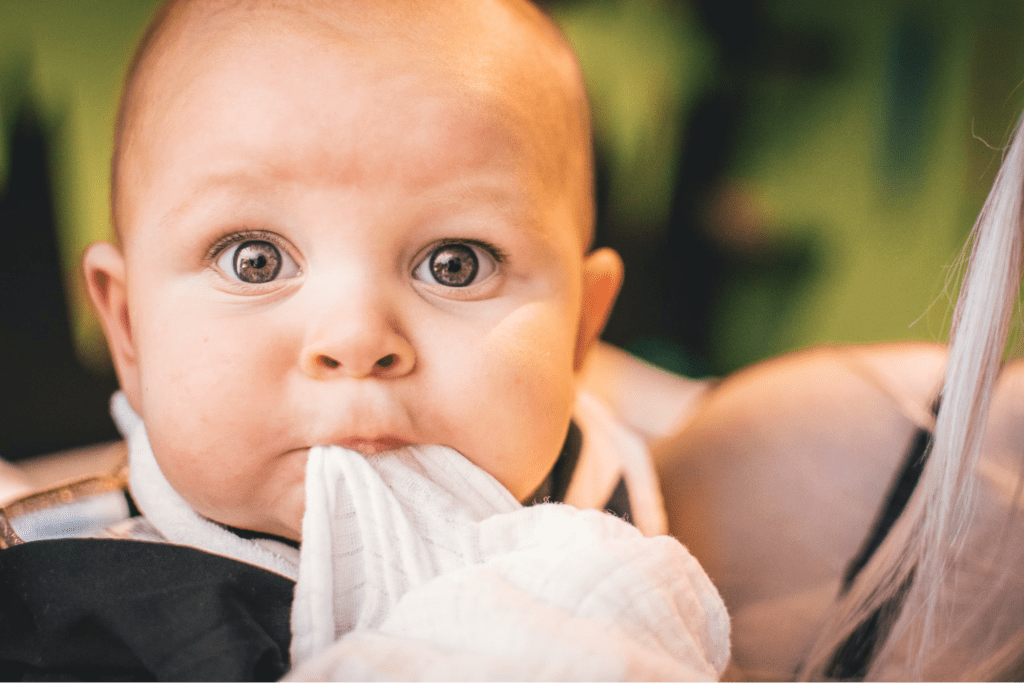
Why can’t you remember being a baby? Most adults cannot recall a specific event from their first few years of life, even though those years are packed with learning, and for a long time the standard explanation was that the infant hippocampus was too immature to store memories. Brain scans of infants now suggest something different: the memories may be formed, then lost from view.
This is an explainer built around a 2025 fMRI study of infant memory published in Science on 20th March 2025 by Tristan Yates, Nicholas Turk-Browne, and colleagues, with older studies for context. The gap in our early memories is called infantile amnesia, or childhood amnesia, and it covers specific episodes such as a birthday party or a first holiday rather than skills like walking or language.
Babies are far from blank slates. Other work has found that infants as young as four months can pick out features of speech sounds, a skill once thought to arrive much later, which is a reminder that their brains are busy learning long before any memory we can describe.

Why can’t you remember being a baby?
Studying the question is hard because the hallmark of an episodic memory is that you can describe it to others, and babies cannot. In Yale’s news release on the study, Turk-Browne said that route is off the table with pre-verbal infants.
So the team used a looking test. Infants aged about four months to two years were shown a new face, object, or scene, and later saw that picture beside a new one. Babies tend to look longer at something they have seen once before, so staring at the old picture counts as a sign of recognition.
That measure is a proxy. Recognising a picture is simpler than recalling an event, so the results speak to whether memories are being recorded, not to what a baby experiences or can later retrieve.
What brain scans of infants reveal
Getting a baby to lie still in an MRI scanner is a feat in itself, which is why much infant brain research uses lighter-touch methods such as EEG, including work on how brain activity at rest relates to infants’ attention. The Yale team has spent a decade developing ways to scan awake infants, and in this study they scanned 26 of them while they looked at the pictures.
The key finding was that the more active an infant’s hippocampus was when they first saw a picture, the longer they looked at it when it came back. The effect was strongest in the posterior hippocampus, the region most associated with episodic memory in adults, and it was clearest in infants older than 12 months, who made up half of the sample. The authors read this as a sign that the ability to encode individual memories comes online during infancy.
The team had earlier found that the hippocampus of infants as young as three months old supports a different type of memory, statistical learning, which extracts patterns across events rather than recording single episodes. Turk-Browne suspected that episodic memory would appear later, and the new results fit that order.
It is a small study of 26 infants, it measured looking time rather than recall, and it does not show how long any memory lasts. Treat it as a strong early clue, not the last word.
Is it forgetting rather than never recording?
If memories are being encoded, something must happen to them afterwards. The authors suggest that processes after encoding, which make memories from infancy inaccessible, may be more responsible for infantile amnesia than a failure to record them in the first place. In other words, the problem may be retrieval, not storage.
Animal research offers one possible mechanism. In a 2014 study on hippocampal neurogenesis and forgetting in Science, Katherine Akers and colleagues found that boosting the birth of new neurons in the hippocampus after learning caused forgetting in adult mice, while slowing neurogenesis in infant mice, which have high rates of it, reduced forgetting. One interpretation is that a flood of new neurons reshapes the circuits that hold early memories and makes them harder to find. These are animal experiments, so the link to human babies remains a hypothesis.
Forgetting also carries on well after infancy. In a 2014 study of children’s memories of events at age 3 in Memory, Patricia Bauer and Marina Larkina found that children tested at 5, 6, and 7 years remembered 60% or more of those events, while children tested at 8 and 9 years remembered fewer than 40%. The authors highlight the importance of forgetting processes in explanations of childhood amnesia, and the study concerns events at age 3, not infancy.
What this means for your own memories
Not remembering your first year is normal, and it says nothing about your childhood or your brain today. Many people’s sense of their earliest years is also rebuilt from photographs and family stories, which can feel like memory without being one.
Turk-Browne has said he suspects the memories may still be there but inaccessible, and his team is testing how long they last through childhood, with only tentative pilot results so far. He calls the idea that they might endure in some form into adulthood “almost sci-fi”, and no study has shown that adults can retrieve them.
If you are worried about memory problems as an adult, that is a different matter from infantile amnesia. A GP is the right first step.
FAQs
- What is infantile amnesia? It is the inability of adults to recall specific events from roughly their first few years of life, also called childhood amnesia. It affects episodic memories, such as a particular party, not skills or general knowledge.
- Can babies form memories? The 2025 Yale study suggests the hippocampus encodes individual memories in infancy, with the link to later recognition clearest after about 12 months. The study measured how long infants looked at pictures, so it shows recognition, not recall.
- At what age do children start to forget early memories? In Bauer and Larkina’s study, children tested at 5 to 7 years remembered 60% or more of events from age 3, while those tested at 8 and 9 years remembered fewer than 40%. Forgetting appears to speed up in the middle of childhood.
- Does this study prove early memories are still stored? No. It shows that memories can be encoded in infancy and suggests that retrieval may be the problem, but it cannot show that they last into adulthood, and Turk-Browne describes that idea as speculative.
- Is it a problem if I cannot remember my early childhood? No. Infantile amnesia is universal in adults, and it is not a sign of a memory problem. If you are worried about memory in adulthood, speak to your GP.
Takeaway
Brain scans of infants suggest that the hippocampus can record individual memories from around the age of one, so the blank in our early years may be more about getting memories back than ever making them. The evidence comes from a small study of recognition, with animal work offering one possible mechanism, and it cannot yet say whether those memories survive. Not remembering being a baby is normal, and it is one of the more intriguing quirks of human memory.


