
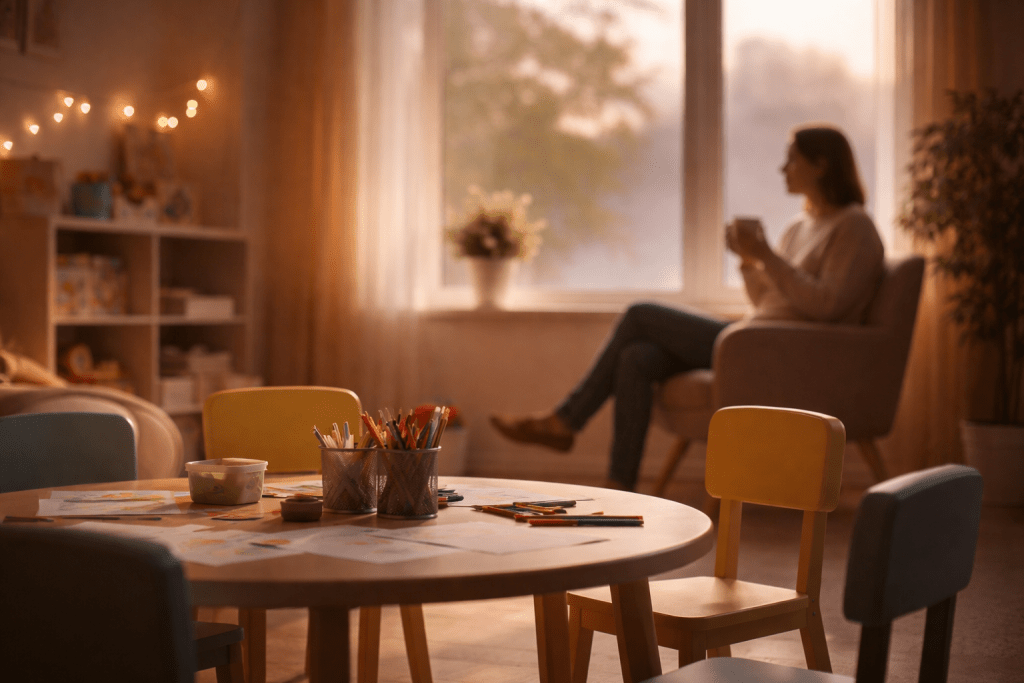
There is a moment, usually in the first week, when a live-in caregiver understands what she has actually signed up for. It comes at about 9 p.m. Work is, by any normal definition, done. The client is settled. And she brushes her teeth in a bathroom that isn’t hers, in a house that goes quiet in a way her own home never does, and realises: there is no commute out of this job. She is not going home from work. She is going to sleep at work, and she will wake up at work, and the person in the next room (whose health is her responsibility) will be the first face she sees.
I have done live-in care in Los Angeles for six years. It is good work, and I mean that. But it is psychologically unlike almost any other job, and the reasons are worth naming, because naming them is most of what makes it survivable.
The border that isn’t there
Every other job, even the demanding ones, has an edge. You leave the ward, the office, the building, and some part of your brain files the day away. Live-in care has no edge. The caregiver is a professional at the breakfast table and a guest in the house by evening and on call in between; and switching between those roles is not a commute, it’s an act of will, repeated daily.
That ambiguity cuts both ways. Being treated “like family” is the compliment every family intends kindly, and it is also how boundaries quietly dissolve. Family doesn’t clock out. Family doesn’t mind one more thing after dinner. The caregivers who last are the ones who learn, usually the hard way, that being warm and being boundless are different things; and that a client is best served by a caregiver who is still a person, with a life of her own somewhere, rather than a permanent resident of somebody else’s emergency.
Sleeping with one ear open
Ask live-in caregivers what the job costs and most won’t mention the lifting or the laundry. They’ll mention sleep. Not the hours: the quality. There is a particular kind of rest you get when part of you is listening: for the bedside bell, for footsteps that shouldn’t be happening, for the change in breathing from the next room. Researchers who study on-call workers have a name for the shallowness of that sleep; caregivers just call it theirs.
The psychology of it matters more than the physiology. A caregiver who has slept badly for three nights is not simply tired. She is shorter with the client’s daughter on the phone. She is slower to find the patience that dementia care runs on. She starts, quietly, to do math about quitting. Broken nights are the tax this work collects, and arrangements that pretend the nights are restful (that write “sleeps through the night” over a client who does nothing of the sort) are spending their caregiver’s mental health as if it were free. It isn’t. It’s the budget everything else comes out of.
The loneliness of being surrounded
Here is the paradox nobody warns you about: live-in care is lonely, and it happens in a house full of people. The client’s family comes and goes with their real lives. The client may be wonderful company or, with dementia, company that resets every twenty minutes. Meanwhile the caregiver’s own friends keep ordinary hours in a city she’s technically in but not living in. Whole days pass where every conversation she has is one she is being paid to have.
That isolation is why the small rituals matter so much: the morning call, the group chat with other caregivers, the walk that is genuinely off-duty and defended like an appointment. Rotations help: most live-in caregivers work a few days on and take real days away, and that rhythm, honestly kept, is the difference between a career and a slow collapse. Where the rotation is a fiction (where days off are spent covering the same house by phone) burnout isn’t a risk. It’s a schedule.
What actually helps
Nothing exotic. A door that locks, because privacy is not a luxury in a house you can’t leave. A written agreement about nights and relief, made before the first shift, because memory edits contracts that exhaustion is a party to. One relationship (a friend, a sibling, another caregiver) that gets the unedited version of the day. And the discipline of remembering that the client is not your family and the house is not your home, however much it comes to feel like both. That sentence sounds cold. It is actually what makes the warmth sustainable: care given by someone who knows where she ends and the job begins doesn’t curdle into resentment at month three.
The families who get this (who protect the caregiver’s sleep, honour the days off, and treat the arrangement as a job held by a person rather than a service delivered by a house) keep their caregivers for years. The ones who don’t, churn through strangers and wonder why. The psychology of the 24-hour caregiver isn’t a footnote to how care works. In a home where one person is the whole system, it is the system.
Vincent Cruz is a live-in caregiver in Los Angeles with six years of experience and the founder of Only Livein, a job board and pay index covering live-in caregiver cases across the US. Only Livein is operated by Grabshop Trading Individuals LLC.


