
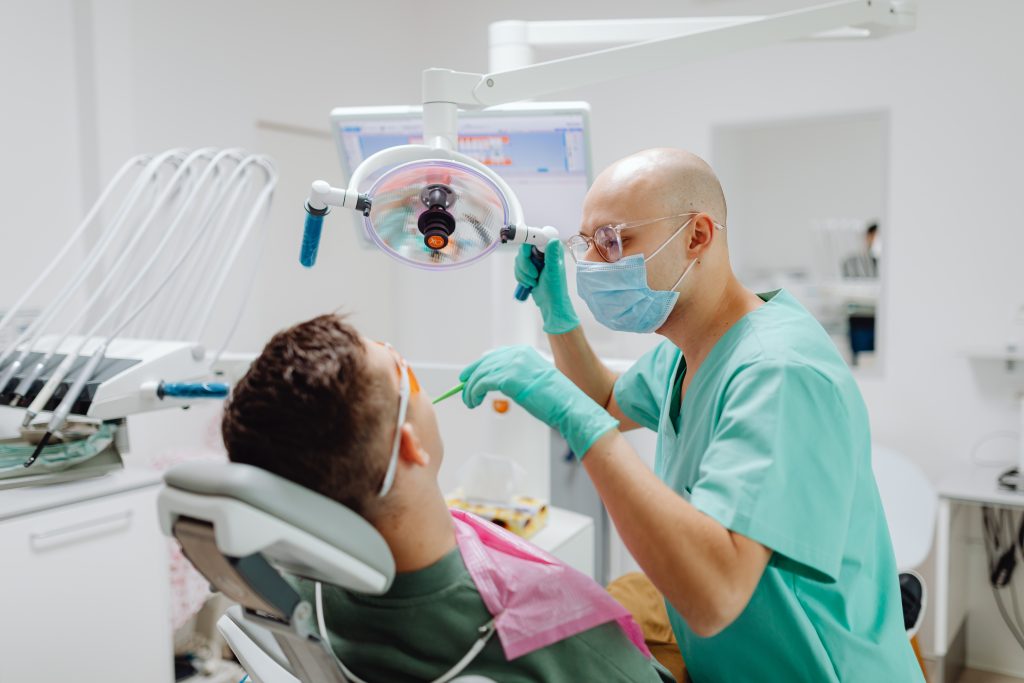
Dental anxiety continues because skipping a visit alleviates the fear immediately and this teaches our brains that skipping visits is the correct behaviour for such situations, so each skipped or missed appointment makes it less likely that you will be able to attend the next one. In the meantime, the teeth get worse so when the person finally goes the dentist, the treatment involved is more invasive and more likely to hurt, resulting in the fear being justified and the whole process being repeated. This type of anxiety is not a normal form of anxiety and it persists for long periods of time, which is why dental fear is quite unusual. The fear of flying or the fear of spiders gradually disappears with the passage of time and distance, as there is no decay, destruction or deterioration of a thing while you are avoiding it. Neglected molars continue to be a problem and decay further.
About one in ten adults have dental anxiety that prevents them from going for dental appointments and a consistent pattern found in the studies of dental phobia or avoidance patients is that the average period of time when they do not see a dentist is several years as contrasted with merely a couple of months. Realising that the key lies in the fear-avoidance cycle and not a weak or defective individual changes our perception of what a solution should look like.
What actually triggers dental anxiety?
The trigger people underestimate is loss of control. You are lying down, the dentist is in front of you with the instruments. No way to move or talk. A dental chair is a physical situation that triggers fear in individuals with a history of powerlessness, trauma, or both. It’s the dental chair and the whole scenario before even a drilling begins; the patient is already traumatised. It is common that people who had a bad dental experience or even a single one cite it as the trigger.
People mostly cite past experience as a trigger. It is usually one specific event rather than several general ones. For instance, a patient who couldn’t believe he was experiencing it (the whole failure) the staff telling him that, etc. And a dental doctor who didn’t respect the patient’s “No” and didn’t stop when they asked. Back in the “gas” era when children would be taken out for an extraction, this routine left an entire generation with a fear they’ve never looked into as adults. In studies about dental anxiety the dental anxiety predictor that has turned out to be the most reliable and consistent one is a dental care provider who is dismissive or dominating.
Needle phobia is a separate issue, some of them have the vasovagal component, causing not panic but fainting. The fear of choking, if someone has a strong gag reflex, is genuine and not related to pain at all. Shaming a tooth or bad breath is the reason some people avoid dentists and this is very rarely talked about. Different approaches are necessary for different individuals if shame or fear of needles is the barrier- so generic reassurance fails a lot.
How is dental anxiety assessed?
Better dentists do not make a guess or guesswork. They actually measure the situation. The tool that best reflects dental fear or anxiety is MDAS: the Modified Dental Anxiety Scale. It’s a five-question survey that is the common one in the UK. The scale goes from 0–25. Generally, a mark of 19 shows that it’s severe dental anxiety or phobia (if you prefer). It only takes one minute to fill it in, and most often it is part of the new patient registration papers.
It doesn’t really matter to the patient how many points they get. The issue is that a documented number transforms the problem from just an impression to a clinical fact in the files. That way the whole dental team knows about it before you come in, you might be given extra time at appointments and nobody has to describe their anxiety to different people more than once. Truth is that if handled properly and well, the scores do come down noticeably after a while of treatment and they may be kept up to date and monitored.
Which treatments have the strongest evidence?
Cognitive behavioural therapy is supported by arguably the most solid body of research among all other methods including the use of sedation. Structured CBT for dental phobia usually lasts from one to ten sessions given the protocol, and the short versions of this therapy delivered in a dental setting rather than by a psychologist have been proven effective. The core is that gradually you confront the feared object, you go to your dentist’s office, nothing harmful happens, the link between unpleasant experience and the visit to the dentist gets weaker and, unlike sedation, this change stays with you for the next session. In reality in-chair techniques have a stronger impact than one may expect.
Moving through the treatment slowly, with the patient having a chance to indicate the moment he or she wants the work to stop, usually the dentist agreeing on a “left hand signal” that the patient will raise if things go too far, and the dentist stopping immediately, brings control of the situation back when it had been in the hands of the other. The tell-show-do method involves showing each instrument before it is used in the mouth and explaining the procedure to avoid the element of the unexpected. Besides, different physical relaxation techniques are suggested; breathing exercises, muscle contraction and relaxing techniques are recommended for people fearing needles, and simple auditory distraction with the use of headphones has a supporting effect but the sizes of the effect are not large.
What sedation options exist and what do they cost?
Nitrous oxide and oxygen inhalant sedation seems to be the milder option of all and the one least used among adult patients. You remain awake during the procedure, the anaesthetic wears off quickly within fifteen to thirty minutes, and it is also very probable that you will be able to get your car after having it fixed. The extra fees for treatment vary from fifty up to one hundred and fifty pounds.
Midazolam-administered intravenous sedation is a more profound form. A vast majority of the patients hardly recall even the appointment. In fact this is the main reason people like it, yet this also points to the possibility of not learning as much from your visit. An adult friend or relative is the one who needs to bring you back home after the procedures and it is impossible for you to drive, work, or make legal decisions for the rest of the day. One can expect to pay about three hundred to six hundred pounds per session in private settings, more so if the visits last longer, and the clinic needs a national sedation level with a trained second person present throughout the whole procedure.
General anaesthesia is reserved for genuine extremes and is delivered in a hospital or registered day-case setting, not a high street surgery. Costs typically start around a thousand pounds and rise steeply. Availability shapes the decision as much as price. NHS access to adult sedation exists but usually requires referral to a community or hospital service with waiting times measured in months, whereas a practice offering private dental care in London can generally arrange sedation within weeks and allocate longer appointment slots to anxious patients. For someone who has avoided treatment for a decade, that scheduling flexibility often matters more than the sedation itself.
What should the first appointment look like?
It means no treatment. A first consultation for a nervous patient is just a discussion, preferably seated upright in a consultation room fully dressed rather than having to lie back in an examination chair and cover the patient’s history, the specific fears, and what circumstances would have to be satisfied for you, the patient, to get back in for another visit. A few practices actually do provide the very first session without a charge, or they only charge a reduced consultation fee mainly because they are aware that this way the rest of their dental services can be offered.
The second visit may be nothing more than taking a short walk round and getting examined with a mirror. The third, if any, might be a quick session with an oral hygienist. Gradually developing the treatment through very small steps by starting with the easiest tooth rather than the most difficult one allows the patient to accumulate successes through their dentists in the form of appointments where nothing went wrong.
For a patient with a high level of anxiety who decides to follow this procedure, the most important thing to do before anything gets booked is to write down in a single sentence the one specific moment that the patient fears the most, and repeat it orally at the first appointment. It would be more helpful not to say “I can’t stand having to go to the dentist” but “I am afraid the needle won’t work and that you will go on regardless.”


